


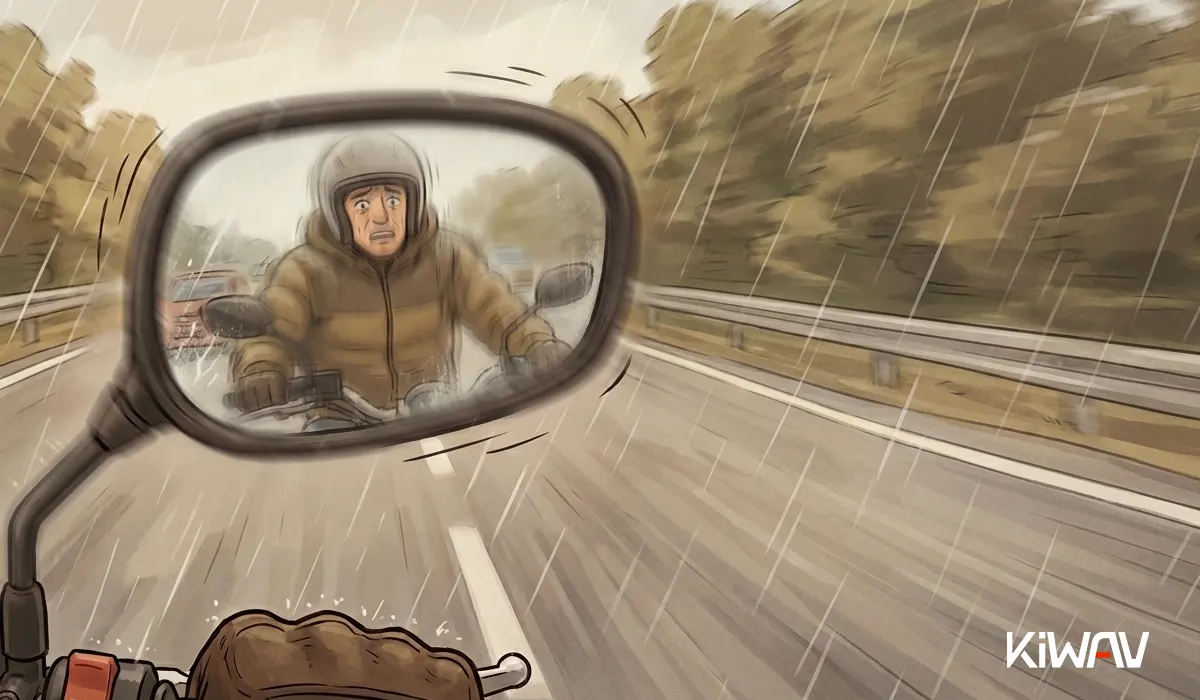
Most riders don’t think about their mirrors until they fail—usually at 100 km/h on a busy highway. From vibrating images to “shoulder-only” views, the frustrations are real. Across rider forums, owner groups, and real-world use, the same failures appear again and again—not because riders choose poorly, but because mirror design is frequently optimized for cost or appearance rather than riding physics. We’ve analyzed the 10 most common reasons why mirrors fail riders and, more importantly, the specific design solutions that turn a frustrating ride into a confident one.
1. Vibration & Blur at Cruising Speed
Why do the stock mirrors shake so badly at cruising speed, and is there a mirror that actually stays clear above 80–100 km/h?
The problem: Mirrors that appear fine at idle become unusable above 80–100 km/h due to vibration amplification at real RPM.
Why it happens:
- Thin stems
- Hollow materials
- Poor mass distribution
- No vibration damping path
Design solution that works:
- Rigid mounting interfaces
- Proper stem thickness and material density
- Balanced mirror head mass to shift resonance outside cruising RPM
2. Seeing Shoulders Instead of Traffic
Why can I only see my shoulders in the mirrors, and which mirrors actually give a usable rear view?
The problem: Riders see elbows and shoulders instead of vehicles behind them.
Why it happens:
- Incorrect mirror offset
- Flat geometry copied from OEM shapes without ergonomic correction
Design solution that works:
- Correct lateral offset built into the mirror
- Geometry designed around real rider posture, not CAD symmetry
3. Mirrors Moving at Highway Speed
Do bar-end mirrors fold or drift at highway speeds, or is there a design that stays locked?
The problem: Bar-end or aftermarket mirrors drifting, rotating, or folding under wind pressure.
Why it happens:
- Cosmetic hinges
- Insufficient joint preload
- Smooth contact surfaces that rely on friction alone
Design solution that works:
- Mechanical locking interfaces
- Serrated or indexed joints
- Wind-load tested clamping force
4. Small Mirrors vs Road Legality
Are small mirrors even safe or legal, and is there a compact mirror that’s still E-marked / compliant?
The problem: Minimalist mirrors that look good but raise concerns about legality or safety.
Why it happens:
- Styling prioritized over reflective surface requirements
- Lack of certification targets during design
Design solution that works:
- Compact mirrors engineered around minimum legal reflective area
- Certification (E-mark or equivalent) considered early, not added later
5. Limited Adjustment Range
Why do some mirrors look great but can’t be adjusted enough for different riding positions?
The problem: Mirrors that look adjustable but don’t work across sport, upright, and ADV riding positions.
Why it happens:
- Single-axis joints
- Limited rotation envelopes
Design solution that works:
- True multi-axis adjustment
- Independent pitch, yaw, and rotation control
- Adjustability designed for different torso angles
6. Folding That Loosens Over Time
Is there a mirror that folds easily for lane-splitting or parking but doesn’t loosen over time?
The problem: Mirrors that fold nicely at first but loosen after weeks or months.
Why it happens:
- Wear at smooth hinge interfaces
- No preload compensation for long-term use
Design solution that works:
- Controlled folding mechanisms
- Wear-resistant joint materials
- Adjustable or self-locking hinge systems
7. Cheap Feel Despite Premium Pricing
Why do so many aftermarket mirrors feel cheap or hollow—what actually separates a good mirror from a bad one?
The problem: Mirrors that feel hollow, light, or fragile despite premium claims.
Why it happens:
- Cosmetic metal shells
- Plastic internal structures
- Faux carbon or surface coatings
Design solution that works:
- Solid aluminum or real carbon fiber structures
- Structural material doing actual load-bearing work, not decoration
8. “OE-Style” That Isn’t Really OE
Are aftermarket OE-style mirrors actually the same size and view as stock, or are they just ‘close enough’ ?
The problem: Aftermarket mirrors marketed as OE replacements but offering reduced visibility.
Why it happens:
- Scaled-down mirror heads
- Shortened stems
- Vague "universal fit" language
Design solution that works:
- Honest OE-equivalent dimensions
- Clear specifications for mirror size and viewing area
- Fitment accuracy over marketing convenience
9. Installation Complexity
Why is mirror installation always more complicated than it should be—threads, adapters, reverse bolts?
The problem: Riders needing extra adapters, reverse threads, or guesswork to install mirrors.
Why it happens:
- Incomplete hardware kits
- Assumptions about regional thread standards
Design solution that works:
- True plug-and-play kits
- Correct left/right thread bolts included
- Installation designed as part of the product, not an afterthought
10. Styling vs Safety Trade-Off
Can a mirror look clean and aggressive without sacrificing rear visibility and riding safety?
The problem: Belief that clean design must sacrifice rear visibility.
Why it happens:
- False dichotomy between aesthetics and function
- Design driven by appearance alone
A mirror that succeeds in these areas will outperform trend-driven designs—regardless of brand.
Design solution that works:
- Industrial design guided by function first
- Clean lines built around visibility and compliance, not against them
How to Evaluate a Motorcycle Mirror Properly (Without Brand Bias)
When choosing mirrors, riders should evaluate:
- Stability at real cruising RPM
- Rear visibility without body obstruction
- Joint strength under wind load
- Legal reflective area
- Long-term durability of moving parts
A mirror that succeeds in these areas will outperform trend-driven designs—regardless of brand.
From here, you can explore: