


Motorcycle riders rely on rearview mirrors more than most people realize. Unlike cars, motorcycles lack structural protection and blind-spot warning systems. A rider’s awareness of surrounding traffic depends heavily on one thing: clear, stable, and reliable rearward vision.
Yet many motorcycles—especially when modified or used at highway speeds—are equipped with mirrors that vibrate, blur, or distort the view behind them. This article explains why high-quality motorcycle mirrors matter, how poor mirrors compromise safety and durability, and what technical factors separate a truly stable mirror from an cheap one.
Vision and Safety: What Is a "Safe Field of View"?
Understanding Field of View (FOV) and Blind Spots
A safe rearview system is not defined by mirror size alone. What truly matters is the usable field of view (FOV)—how much of the area behind the motorcycle the rider can clearly see without excessive head movement.
Blind spots on motorcycles are typically caused by:
- Narrow mirror angles
- Inappropriate mirror curvature
- Excessive vibration that turns sharp details into visual noise
A proper mirror setup should allow a rider to monitor adjacent lanes, approaching vehicles, and closing speed with minimal distraction.
Features that actually improve comfort, clarity, and confidence → Read: Why Some Mirrors Feel Better in Daily Riding
Common Rearview Mirror Problems
Many riders experience the same issues:
- Blurry images at certain engine speeds
- Double images or ghosting, especially at highway speeds
- Distorted reflections that make it difficult to judge distance
These problems are not inconveniences—they directly affect reaction time and decision-making, particularly during lane changes or emergency braking.
Flat vs. Convex Mirrors
Mirror curvature plays a critical role in visibility:
- Flat mirrors provide accurate distance perception but limited coverage.
- Convex mirrors increase FOV and reduce blind spots, at the cost of slight image distortion.
A well-designed convex mirror balances curvature carefully, expanding visibility without making vehicles appear unrealistically distant.
Compare the difference between flat and convex mirrors → Understanding how different mirror curvatures affect your visual field
How Vibration Destroys Rearward Vision
Common Sources of Motorcycle Vibration
Motorcycles generate vibration from multiple sources:
- Engine configuration (single-cylinder engines produce strong low-frequency vibration)
- High-RPM operation in parallel twins and four-cylinders
- Frame resonance and handlebar harmonics
- Road surface feedback transmitted through the chassis
Even small vibrations become problematic when amplified by mirror arms and mounting points.
Why Inexpensive Mirrors Vibrate More
Low-cost mirrors often fail for predictable reasons:
- Thin or poorly cast mirror arms
- Loose or imprecise pivot joints
- Lightweight mirror housings with insufficient rigidity
- Inconsistent assembly tolerances
Vibration is rarely caused by one component alone. It is usually the result of stacked weaknesses throughout the mirror structure.
The Structure of a High-Quality Motorcycle Mirror
Pivot and Joint Quality
The pivot or hinge is one of the most critical components:
- Poorly designed pivots loosen over time
- Single-point locking systems allow micro-movement
- Inconsistent friction surfaces accelerate wear
High-quality mirrors use controlled friction interfaces and stable joint geometry to maintain position even under sustained vibration.
Mirror Arm Construction: CNC vs. Cast vs. Die-Cast
The mirror arm determines how vibration travels through the system.
- CNC-machined aluminum arms offer high rigidity and precise geometry.
- Cast aluminum arms are more variable in density and stiffness.
- Die-cast arms are economical but often lack structural consistency.
Rigidity matters. A stiffer arm resists oscillation and prevents resonance from building.
Mirror Glass: Glass vs. Acrylic vs. Aluminum
The material used for the reflective surface plays a major role in how clearly and consistently a rider can see what’s behind them—especially at speed.
- Glass mirrors provide the most stable and distortion-free reflections. Glass maintains surface flatness under vibration and temperature changes, which is why it remains the standard for high-quality motorcycle mirrors.
- Acrylic mirrors are lighter and less prone to shattering, but they flex more easily and are more susceptible to scratches. Over time, this flexibility and surface wear can reduce image sharpness, particularly on rough roads or high-vibration motorcycles.
- Aluminum reflective surfaces are created by polishing the aluminum mirror base itself and applying a thin reflective coating. While this approach reduces weight and simplifies construction, it comes with trade-offs. Aluminum is structurally softer than glass and more sensitive to vibration-induced micro-flex. Even slight deformation of the reflective surface can introduce visual distortion, ghosting, or loss of clarity at speed.
At the time of purchase, these differences may not be immediately obvious. Many mirrors appear clear and acceptable when new and properly adjusted. Over time, however, as the mirror is exposed to repeated vibration, temperature changes, and real-world riding conditions, surface stability becomes increasingly important.
The ability of a mirror to resist micro-flex—both in its structure and in the reflective surface itself—determines how well image clarity is preserved as the miles accumulate.
Think all mirror surfaces are basically the same? → Industry secret: The Hidden Downsides of Motorcycle Mirrors Made with Aluminun Reflective Surfaces
Surface Finishing and Environmental Resistance
Long-term mirror performance is shaped not only by structure and materials, but also by how well the mirror resists environmental exposure over time. This applies to both metal and non-metal mirror.
- Metal mirror, such as aluminum or steel, offer a solid and premium appearance. However, their durability depends heavily on surface treatment. Inconsistent anodizing, thin paint layers, or uneven chrome plating can allow moisture intrusion, leading to oxidation, corrosion, or surface degradation over time.
- Plastic mirror do not rust and are typically lighter. Their long-term performance depends on polymer quality and coating thickness. Low-grade plastics may fade, become brittle, or show surface wear after prolonged UV exposure, while well-finished plastic housings with proper coatings can remain stable and visually consistent for years.
Neither material is inherently superior in all conditions. The real difference lies in execution quality—the consistency of coatings, the thickness of protective layers, and how well the housing is sealed against moisture, heat, and environmental stress.
Durability is not purely cosmetic. Surface degradation can affect structural integrity, fastener stability, and long-term vibration behavior. A mirror that maintains its finish is more likely to maintain its performance.
High-Quality vs. Low-Quality Mirrors: A Practical Comparison
| Aspect | High-Quality Mirror | Low-Quality Mirror |
|---|---|---|
| Image clarity | Sharp, stable | Blurry, distorted |
| Vibration control | Controlled, damped | Amplified, resonant |
| Longevity | Multi-year durability | Loosens quickly |
| Corrosion resistance | Strong resistance | Inconsistent protection |
| Safety margin | Reliable visibility | Reduced awareness |
| Finish | Smooth, refined | Rough, thin coating |
A mirror that vibrates may still be legal—but legality does not equal safety.
Frequently Asked Questions
Q: Why does my mirror vibrate at certain RPMs?
Because the mirror assembly resonates at specific frequencies generated by your engine and chassis. Weak joints and flexible arms amplify this effect.
Q: Can mirror vibration cause inspection failure?
In many regions, excessive vibration that prevents a usable rearward view can fail safety inspection, even if the mirror is physically present.
Q: Which material offers the best vibration resistance?
Structural rigidity matters more than weight alone. CNC-machined aluminum combined with a rigid mirror base offers superior stability.
Q: Are larger mirrors always safer?
Not necessarily. A poorly stabilized large mirror can be less effective than a smaller, well-designed mirror with a clear, stable image.
Engineering Focus: KiWAV Mirror Technology
Vibration Control by Design
KiWAV mirrors are developed with vibration control as a primary design requirement, not an afterthought. Structural stiffness, joint stability, and mirror surface integrity are addressed as a complete system.
Controlled Surface Finishing for Long-Term Performance
Beyond choosing high-quality materials for the mirror housing and arm, KiWAV mirrors use thicker, precision-applied coatings on both metal and plastic housings to resist UV, corrosion, and wear. Uniform finishing ensures long-term stability, reduces micro-flex, and helps the mirror maintain clear reflections and consistent performance under real-world riding conditions.
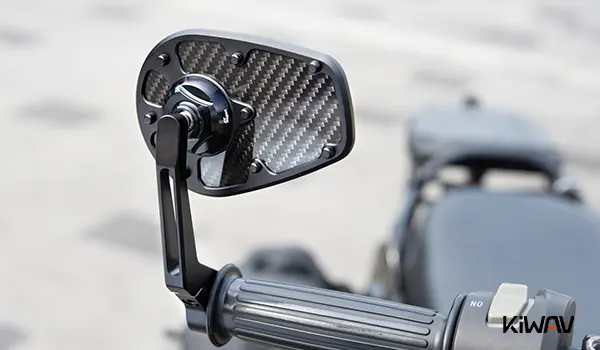
Mamba Series: Carbon Fiber Mirror Plate Advantage
Unlike mirrors that use plastic mirror bases with a carbon-look finish, the Mamba Series uses real carbon fiber mirror plates. Carbon fiber offers:
- High stiffness-to-weight ratio
- Reduced resonance at high frequencies
- Long-term dimensional stability
This structure minimizes flex under vibration and maintains image clarity at speed.
The Minimal Series: Safety Through Adjustability
The Minimal series focuses on adaptability and positioning:
- Wide adjustment range
- Stable locking geometry
- Consistent visibility across different riding postures
Better adjustability means fewer blind spots and more predictable rearward awareness.
What's Next
Rearview mirrors are often overlooked until they fail to perform. A mirror that vibrates, blurs, or shifts position compromises situational awareness—one of the most critical elements of motorcycle safety.
High-quality motorcycle mirrors are not about aesthetics or brand prestige. They are about engineering discipline, material integrity, and real-world stability. When those elements come together, the result is not just a better mirror—but a safer ride.
From here, you can explore: