


For a cup-style oil filter wrench, match the diameter at the filter’s fluted end and the number of flutes. Then check the end shape, engagement depth, and space around the filter. Use the filter currently installed on your vehicle as your starting point. The vehicle model alone does not confirm which cap wrench will fit.
This guide helps you choose a cap-style removal tool. If your vehicle has a replaceable cartridge inside a reusable housing, identify the housing cap and its tool requirements separately.
1. Identify the filter you need to remove
Record the brand and complete part number of the installed filter, if visible. Take a photo of its closed end and the surrounding space. A replacement filter that fits the same engine can have a different external shape, so the new filter in the box may not tell you which wrench will remove the old one.
2. Measure where the cap wrench grips
For a fluted spin-on filter, measure the shaped area around the closed end—the end the cup wrench slides over. Do not use the threaded opening, sealing gasket, or rolled mounting rim as your wrench-size measurement.
- Place the outside jaws of a vernier or digital caliper across the fluted gripping area.
- Record the reading in millimeters and note exactly where the jaws touch: flat-to-flat, corner-to-corner, or another profile shown in the tool’s drawing.
- Compare the same measurement points with the selected wrench’s dimension drawing. Also check how much of the fluted section the cup can engage.
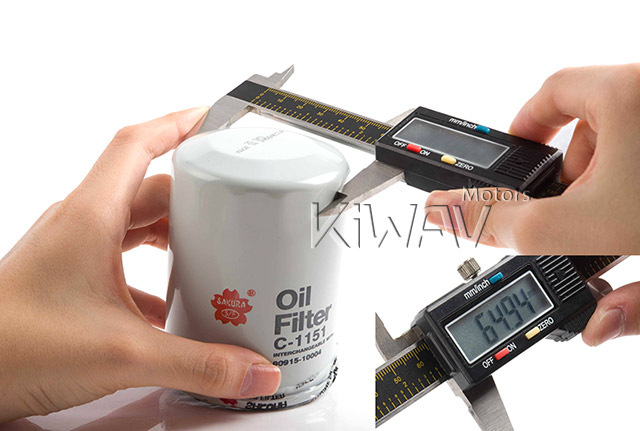
Do not simply round a reading to the nearest product name. Labels such as 65 mm, 65/67 mm, and 74/76 mm are nominal product sizes. They are not a universal measurement rule or a continuous adjustable range. A diameter match alone is not a fit guarantee.
3. Count the flutes around the same end
Flutes are the repeated shaped gripping sections around the filter end. Mark one section as your starting point, then count each matching section once around the full perimeter. Stop when you return to your mark. Do not count both a section and its separating edge as two flutes.
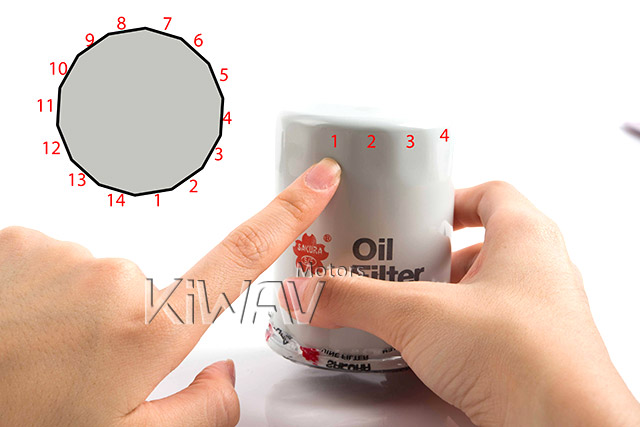
For example, KiWAV lists 76 mm cap wrenches with 8, 12, and 14 flutes. These are different profiles; choosing “76 mm” without checking the flute count is not enough.
4. Compare KiWAV oil filter cap wrench sizes
Use this table to find the product page for your measured profile. The diameter column shows KiWAV’s nominal product labels, not exact caliper readings or a vehicle-fitment chart. Confirm the product’s dimension drawing, application notes, and clearance before ordering. Availability is shown on each product page.
| Nominal diameter | Flutes | KiWAV product | Before ordering |
|---|---|---|---|
| 65 mm | 14 | 65 mm × 14 flutes | Check the end profile; this version excludes rubber-coated filter ends. |
| 65/67 mm | 14 | 65/67 mm × 14 flutes | Compare the measurement drawing with your filter; do not assume interchangeability with the 65 mm version. |
| 68 mm | 14 | 68 mm × 14 flutes | Match the end profile and check available engagement depth. |
| 74/76 mm | 15 | 74/76 mm × 15 flutes | Requires the matching 15-flute profile. |
| 76 mm | 8 | 76 mm × 8 flutes | Match the 8-flute end shape shown on the product page. |
| 76 mm | 12 | 76 mm × 12 flutes | Confirm this profile with KiWAV before ordering if your measurements are unclear. |
| 76 mm | 14 | 76 mm × 14 flutes — standard version | The listing excludes applications with a crank sensor; check the separate crank-sensor version. |
| 76 mm | 14 | 76 mm × 14 flutes — crank-sensor version | Check the product-specific application limits and clearance around the filter. |
| 80 mm | 15 | 80 mm × 15 flutes | Compare the measurement drawing and end profile. |
| 86 mm | 16 | 86 mm × 16 flutes | Confirm the exact filter or housing cap design as well as the size. |
| 93 mm | 15 | 93 mm × 15 flutes | Check current availability on the product page. |
| 93 mm | 36 | 93 mm × 36 flutes | Check current availability; this is the 36-flute listing. |
| 100 mm | 15 | 100 mm × 15 flutes | Compare the measurement drawing and end profile. |
Browse all KiWAV oil filter cap wrench options. Select both the diameter and flute count to view the chosen version’s details.
5. Recheck the size when changing filter brands or part numbers
The same vehicle can accept replacement filters with different external gripping profiles. Keep these two checks separate:
- For this oil change: choose the removal wrench for the filter currently on the engine.
- For the next oil change: record the new filter’s brand, part number, flute count, and gripping dimensions before installing it. Confirm whether your existing wrench matches that filter too.
If the new filter has a rubber-coated end, a different flute pattern, or a different end design, recheck compatibility. The KiWAV 65 mm × 14-flute listing specifically excludes rubber-coated filter ends. Matching the engine application does not automatically mean the same cup wrench will fit.
Common questions
Can I choose an oil filter wrench by vehicle model alone?
Use the vehicle model to narrow the search, then confirm the installed filter’s brand, part number, diameter, flute count, and end shape. A previous owner or service shop may have changed the filter brand.
Are all 76 mm oil filter wrenches the same?
No. The flute count and tool shape matter too. KiWAV also has separate standard and crank-sensor versions of its 76 mm × 14-flute wrench, so check surrounding clearance and each listing’s restrictions.
Will a 65 mm wrench fit a filter measuring close to 65 mm?
That reading helps narrow the choice, but it is not enough on its own. Confirm where the measurement was taken, the flute count, end profile, and any coating. Compare the specific tool drawing before ordering.
What if the cap wrench slips or will not seat properly?
Stop and recheck the size, flute pattern, end coating, and obstructions. Do not force a mismatched cup into place. If the filter is damaged or you cannot identify its profile, ask for help before choosing another size.
Can I use the wrench to tighten the new filter?
Choose this tool for removal. Follow the filter and vehicle manufacturer’s installation instructions; do not assume a removal wrench is required for tightening. Reusable cartridge-housing caps have their own service procedure.
Need help choosing the correct version?
Send KiWAV the filter brand and part number, a clear end-on photo, your caliper reading with the contact points visible, and a photo showing the space around the installed filter. Include the vehicle year and model as supporting information.